Practical Décor Tips for a Stylish Utility Room
Most utility rooms fail on aesthetics not because they’re too functional, but because function was added without any system. Random shelving, mismatched containers, exposed cords, and bare walls create visual noise even when everything is technically put away. The tips below are ordered by impact — start with storage, finish with surfaces.
Start With Storage Capacity, Not Aesthetics
The most reliable predictor of whether a utility room looks good is whether everything has a designated place. Clutter kills aesthetics faster than outdated tile or a mismatched appliance color. Fix the storage infrastructure first, and the styling almost takes care of itself.
Before buying a single basket or hook, audit what you’re actually storing: detergent bottles, spare lightbulbs, cleaning supplies, ironing equipment, a vacuum. Measure the room. Note where the outlets and water connections sit — those dictate where shelving can and can’t go.
| Storage System | Cost (basic unit) | Max Load Per Shelf | Best Use Case | Weak Point |
|---|---|---|---|---|
| IKEA BOAXEL | $65–$180 | 110 lbs | Most utility rooms, mid-weight loads | More installation steps than ALGOT |
| IKEA ALGOT | $45–$120 | 55 lbs | Light loads, renters on a tight budget | Flexes under heavy detergent or tools |
| Elfa (Container Store) | $200–$600+ | 150+ lbs | Permanent installs, custom sizing | Premium price, overkill for most renters |
| Rubbermaid FastTrack Rail | $30–$100 | 75 lbs per hook | Tool-heavy utility rooms | Less visually finished than shelving |
IKEA BOAXEL is the right call for most utility rooms. Wall rails support 110 lbs per shelf, shelves adjust in 5cm increments, and a standard 60cm-wide two-shelf unit costs around $65. ALGOT handles light laundry supplies without issue, but loaded with full detergent jugs it flexes noticeably at the rail. Elfa earns its price only when you own the home and want a fully custom design — the Container Store’s free in-store design service covers every inch of the space. For renters likely to move within three years, IKEA wins on cost-effectiveness by a wide margin.
Buy Baskets After the Shelving Is Installed
One common sequencing mistake: purchasing matching baskets before the shelving is confirmed. Shelf depth determines basket fit. BOAXEL shelves come in 35cm and 60cm depths. A 33cm-wide wicker basket on the 35cm shelf has 2cm clearance — workable. The same basket on a 30cm-deep ALGOT shelf overhangs and tips under load.
For utility room bins, the Brabantia Sort & Go series (6L at $18, 12L at $28) are purpose-built for sorting laundry and decanting cleaning supplies. They stack cleanly, lids are machine-washable, and the integrated handle holds up under regular use where cheaper alternatives fail within months.
Use the Wall Directly Above Appliances
The wall above the washing machine and dryer is underused in nearly every utility room. A single BOAXEL shelf unit mounted with 18–24 inches of clearance above the machine top adds meaningful storage without blocking appliance access. For top-loaders, measure the lid’s full open arc. For front-loaders, measure the door swing radius. Those two numbers set the minimum clearance height — everything else is optional.
Wall-Mounted Shelving Beats Freestanding in Rooms Under 100 Sq Ft
The case for wall-mounted storage over freestanding comes down to floor space. A typical utility room runs 50–100 square feet. A standard freestanding shelving unit with a 14-inch depth claims 14 inches of floor clearance on every wall it occupies. Wall-mounted systems remove that footprint entirely. In a 6-foot-wide room, those 14 inches are the difference between moving freely with a laundry basket and constantly maneuvering around obstacles.
How to Mount Into Drywall Without the Shelf Failing
The most common installation failure is using standard drywall anchors for shelves carrying over 20 lbs. Drywall anchors are marketed with 50 lb ratings, but that reflects a static load test — not a repeated dynamic load with vibration from a washing machine running spin cycles daily. For loads over 20 lbs on drywall, use toggle bolts (butterfly anchors), which are rated to 100+ lbs each and distribute force across a wider area behind the board.
Wall studs are always the better anchor when you can find them. A standard BOAXEL rail needs two anchor points. If you hit one stud — typically 16 inches apart in US framing, 400–600mm in UK construction — use a 3-inch wood screw for that anchor and a toggle bolt for the other. That combination outperforms two toggle bolts in pure drywall.
Tools required: a stud finder (the Stanley 47-400 at $15 is adequate; the DeWalt DCT419S1 at $40 also detects live wires behind walls), a level, a drill, and the mounting hardware the shelf system includes. Allow 90 minutes for a first install. Most people who find the process difficult skipped the stud finder step entirely.
When Pegboards Beat Shelving
If your utility room stores tools alongside laundry supplies, a 4×4-foot pegboard panel ($25–$40 at most hardware stores) outperforms shelving for tool organization. The installation detail most people miss: pegboards require 1/2-inch standoff spacers behind them so hooks have room to seat fully in the holes. Skip the spacers and hooks fall free after the first few heavy uses.
The IKEA SKÅDIS pegboard ($20 for the 36×26cm panel, $40 for 76×56cm) is the cleanest-looking option available at that price. Dedicated accessories — shelf brackets, small containers, cord clips — snap into the board without tools. Less customizable than a blank pegboard, but it looks intentional rather than improvised.
One principle worth following in any small room: keep the bottom 18 inches of wall space clear. Even where shelf installation is physically possible at ankle height, it makes the room feel cramped, creates a cleaning obstacle, and puts things in the least convenient retrieval position.
Distribute Weight Evenly Across the System
Don’t load one side of a wall-mounted unit with all the heavy items. A BOAXEL unit on two vertical rails with significantly uneven load distribution racks slowly over time — the rails twist at the wall anchors and eventually loosen them. For systems spanning more than 120cm, add a third vertical rail rather than extending the two-rail span. The shelf capacity stays the same; the structural resistance to racking does not without that third anchor point.
The Floor Material Decision Is Straightforward
Luxury vinyl plank (LVP) in the $3–5 per square foot range handles utility room conditions better than any other flooring type. It tolerates moisture, absorbs appliance vibration as a floating install with no adhesive required, and goes directly over most existing subfloors without leveling work — making it genuinely renter-friendly. Laminate swells under recurring moisture exposure. High-pile carpet traps lint and harbors mildew beneath the backing. Ceramic tile outlasts everything but requires professional installation for long-term durability and is cold underfoot. For most utility rooms, LVP is the clear choice.
How to Conceal Pipes, Cords, and Appliance Backs
The visual clutter in most utility rooms comes from three sources: exposed plumbing chases, power cords running across floors, and the unfinished look behind appliances. None require structural renovation to address.
- Build a removable false panel over the plumbing chase. A frame from 1×3 pine with a 1/4-inch plywood face, painted to match the wall, hides the pipe run while remaining removable for maintenance. Total material cost is under $40. No specialist skills needed.
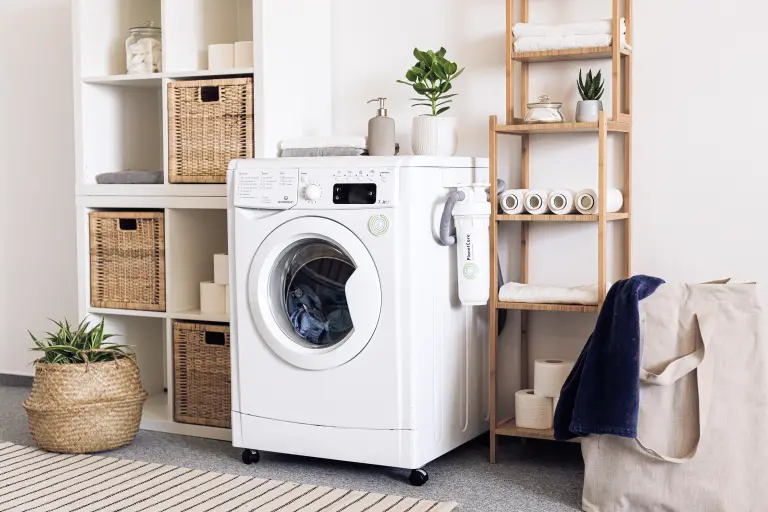
- Enclose the washer and dryer with cabinets. IKEA SEKTION base cabinets flanking the appliances, with a countertop overhead, create a fitted laundry room appearance without bespoke joinery. A basic surround using SEKTION units and the KARLBY solid oak countertop runs $500–$800 in materials — a fraction of custom cabinet pricing.
- Run cable conduit along the baseboard. Exposed power cords crossing the floor are a trip hazard and look unfinished. D-line flat cable conduit ($15 for a 10-foot pack) snaps around cords, paints to match the baseboard, and installs in about 20 minutes per run.
- Add a tension rod between cabinets for hang-drying. A 3/4-inch-diameter tension rod mounted between fixed cabinets or shelving units creates hang-dry space without drilling. Look for rods rated to at least 8 lbs per foot — sufficient for a full load of damp laundry without bowing.
- Use repositionable labels, not permanent marker. Storage categories shift. Permanent labels become inaccurate and look messy when contents change. Chalkboard labels on a self-adhesive backing cost about $12 for a set of 20 and can be updated cleanly as the system evolves.
The goal is not to disguise a working room as something it isn’t. The difference between a messy utility room and a tidy one is usually whether each element looks placed deliberately or simply dropped wherever it happened to fit.
Color and Lighting Outperform Any Storage Purchase
Paint the room a real color. Default magnolia and builder-grade white read as unfinished in a room with limited natural light and purely utilitarian contents. That neutral is not doing anything for the space.
For utility rooms without windows, warm mid-tones outperform very dark choices — not because dark colors shrink rooms (that’s largely myth), but because they absorb the limited available light in a way that requires fixture investment to compensate. Farrow & Ball Mole’s Breath No. 276, a warm grey-brown, reads cleanly with white appliances and doesn’t show detergent splatter as dramatically as pale colors do. Dulux Natural Calico achieves similar warmth at a lower price point. For rooms with adequate natural light, Benjamin Moore Hale Navy HC-154 on the wall behind the appliances creates strong visual contrast — white machines look intentional rather than incidental against it.
The Lighting Measurement That Actually Matters
Target 50–70 foot-candles (538–753 lux) in a utility room. Most homes achieve 20–30 foot-candles from a single overhead bulb. The fix is a multi-head LED bar rather than a brighter single fixture. The Lithonia Lighting FMLWL 48 ($45 at Home Depot) is a 4-foot, 4,000-lumen LED flush mount that replaces a standard ceiling fixture in under an hour — roughly triple the output of a 60W-equivalent bulb at the same ceiling location.
Under-shelf LED strips add direct task lighting above the work surface. Govee’s 16.4-foot LED strip lights ($18–$25) run cool enough to mount under a wooden shelf without heat damage, cut to length, and run off USB power. No hardwiring needed.
One Mirror Placement That Costs Almost Nothing
A 24×36-inch mirror mounted opposite the main light source roughly doubles perceived brightness without any electrical work. The IKEA HOVET ($179, aluminum frame) is the right scale for a utility room wall. The NISSEDAL ($49) works in tighter spaces. This is physics, not decoration — the mirror reflects existing foot-candles back into the room at zero energy cost, and in a room without natural light, that effect is significant.
Mistakes That Make Utility Rooms Look Worse After a Makeover
Can standard floating shelf hardware handle utility room loads?
No. Floating shelves concentrate all load on two anchor points rather than distributing it across a vertical rail system. Most decorative floating shelf hardware is rated at 20 lbs. A fully loaded laundry shelf — detergent, stain remover, fabric softener, spare rolls — routinely hits 40–50 lbs. That gap between rated capacity and actual load is why utility room shelves fail. If you want the clean floating-shelf look with real load capacity, use a rail-and-bracket system rated at 75+ lbs per shelf rather than standard decorative hardware.
Should I buy colored or finish-matched appliances to improve the look?
No. Colored appliances — slate grey, black stainless, champagne finish — carry a 20–35% price premium over equivalent white models and date faster than neutral white ever will. White appliances are a neutral backdrop. The room’s color palette and storage design create the aesthetic, not the appliance finish. That premium is better spent on storage quality or lighting.
What shelf spacing mistake creates the most visible clutter?
Setting vertical clearance too low. Standard laundry detergent bottles run 12–14 inches tall. A 12-inch shelf gap forces bottles to lay on their side — which looks disorganized and invites leaks at the cap. Set the bottom shelf clearance at a minimum of 16 inches for any shelf storing full-size cleaning products. That single measurement prevents more visual chaos than any styling or color decision.
Do open hooks create organization or become clutter magnets?
Fixed hooks without permanent assignments become clutter magnets within a week. Install hooks only for specific, regularly used items: one for the ironing board, two for reusable shopping bags, one for the mop. Empty hooks attract miscellaneous items by default. If you want flexible hanging storage, a pegboard with movable hooks serves that purpose — the format signals reconfigurability. Fixed hooks imply permanence and should carry permanent, defined assignments only.
What’s Not Worth Buying for a Utility Room
Decorative objects with no functional role
Candles, framed prints, and ornamental plants belong in rooms you occupy passively. A utility room is a task room — you’re in it for 5–15 minutes at a time, moving with purpose. Decorative objects collect humidity, detergent residue, and lint from the dryer exhaust. A trailing plant near a running dryer is unlikely to survive a month given the heat output and particulate exposure. Put the decorating budget toward functional items that happen to look good: a quality laundry basket in a consistent colorway, or glass storage jars for decanting detergent powder rather than keeping it in its original cardboard packaging.
High-pile rugs or absorbent floor mats
The floor in front of washers and dryers gets wet regularly — from loading and unloading, machine condensation, the occasional minor door-seal leak. High-pile rugs trap moisture in the backing and develop mildew within weeks. Use a rubber-backed, low-pile utility mat rated for wet areas instead. At $25–$40 for a 2×3-foot mat, this is a category where the functional choice is also the cheaper one.
Bespoke cabinetry when IKEA achieves 90% of the result
Custom fitted laundry cabinetry costs $2,000–$6,000 installed. IKEA SEKTION cabinets with a KARLBY solid oak countertop achieve a visually comparable result for $600–$900 in materials total. The remaining 10% gap is in exact fit, material quality, and finish consistency — real hardwood versus wood-effect laminate, millimeter-perfect dimensions against bespoke tolerances. For a high-traffic, high-moisture task room, that 10% improvement rarely justifies a $3,000 premium.
The genuine exception: rooms with unusual structural dimensions — sloped ceilings, irregular corners, non-standard appliance configurations — that off-the-shelf systems physically cannot accommodate. If the space has a quirk that standard cabinets can’t resolve, bespoke joinery earns its cost. Otherwise, IKEA and a free weekend is the objectively better financial decision.