Kitchen Floor Mats Flatten Out Fast — Here’s What Actually Lasts
Kitchen Floor Mats Flatten Out Fast — Here’s What Actually Lasts
Forty-three percent of people replace their kitchen mat within a year of buying it. That’s not a taste change. That’s a product failure rate. I’ve bought and cycled through more than a dozen kitchen mats over eight years of daily cooking, and the pattern is always the same — soft and grippy for three months, then flat and sliding by month seven.
The problem isn’t that kitchen mats are poorly designed categories. It’s that most people don’t know which specs predict durability and which ones are just marketing text. Here’s what I’ve actually learned from living with these products.
Why Kitchen Mats Lose Their Cushion So Fast
Nobody in the industry talks about this honestly, so I will.
The Compression Problem Inside Foam-Core Mats
Most budget kitchen mats under $30 use open-cell polyurethane foam as the cushioning layer. Open-cell foam feels soft because air moves freely through the cell structure when compressed. The problem: that same cell structure collapses under repeated localized pressure. Standing in front of a sink for dishes, or at a stove for cooking, means 80–90% of your weight lands on a 6-inch diameter patch of mat, hundreds of times per week.
After roughly 200–300 hours of standing time — which is about six months of regular cooking — open-cell foam doesn’t spring back to its original height. The spots with the most pressure flatten first. You end up with a mat that’s thickest at the edges and thinnest in the center. Exactly the opposite of useful.
Why the Surface Peels and Cracks at the Edges
Cheap mats bond a thin PVC or polyester surface layer to foam using water-soluble adhesive. Kitchens are wet environments. Water, cooking oil, and cleaning products work into the mat edges over time, break down that adhesive bond, and the surface starts separating — first at corners, then along the long edges, then across the center.
Mats built from single-piece solid PVC construction don’t have a bonded seam to fail. The cushioning comes from the density and flex of the PVC itself, not from a foam insert wrapped in a surface coating. This construction difference is the single biggest predictor of longevity in kitchen mats under $50.
The Curling Problem Is a Manufacturing Issue, Not a Floor Problem
People blame their tile floors when mats curl. Wrong cause. Curling happens when a mat has internal stress from being rolled too tightly during packaging, combined with differential elasticity between its layers. A foam mat with a rubber backing layer curls because those two materials try to contract at different rates after unpacking.
High-density single-material PVC mats hold flat. They don’t have competing layers. Laying them flat in a ventilated room for 24 hours after unpacking is enough to release any minor roll memory from shipping. No furniture weights required.
The curl issue alone eliminates roughly half of the kitchen mat options available under $25. If the product description doesn’t specify construction type — just says “cushioned” or “comfortable” — you’re probably looking at a foam-core mat with a bonded surface layer. Those curl. They flatten. They fail.
PVC vs. Memory Foam vs. Gel: Which Material Actually Wins
I’ve stood on all three material types for extended cooking sessions. The honest comparison:
| Material Type | Cushion Level | Durability | Water Resistance | Typical Price (2-piece set) | Best Use Case |
|---|---|---|---|---|---|
| Solid PVC (leather-look) | Medium | High — no delamination risk | Excellent — fully wipeable | $20–$35 | Daily cooking, wet areas, sinks |
| Open-cell polyurethane foam | High initially | Low — flattens in 6–12 months | Poor — absorbs moisture and grease | $12–$25 | Short-term use, dry areas only |
| Closed-cell memory foam (WellnessMats) | Very High | Very High — 20+ year lifespan | Good — sealed surface | $80–$200+ | Daily 3+ hour cooking sessions |
| Gel-filled (Ergodriven Topo) | High | Medium — gel can shift over time | Good | $60–$100 | Ergonomic focus, long standing |
| Rubber-backed foam (Gorilla Grip Premium) | Low–Medium | High — rubber base holds shape | Medium — foam layer still absorbs | $25–$40 | Grip priority, lighter cooking use |
The WellnessMats Original is objectively the best kitchen mat if budget isn’t a constraint. Closed-cell foam means zero moisture absorption, zero compression over time, and the company backs it with a 20-year warranty at $90–$160 depending on size. It’s a legitimate lifetime buy for someone who bakes bread daily or runs a catering business out of their home kitchen.
For everyone else — people cooking dinner four or five nights a week — solid PVC construction at the $25–$35 price point delivers most of the durability with almost none of the premium cost. The Ergodriven Topo ($99) is excellent for ergonomic standing desk use but overkill for typical kitchen zones where you’re moving constantly rather than standing in one place.
Two-Piece Sets vs. One Long Mat: Buy the Set
Single long mats look better in product photos. In real kitchens, they’re a design compromise that usually fails within eight months. Here’s why I always recommend the two-piece configuration.
Kitchens aren’t arranged for continuous single-line standing. You stand at the sink for dishes. You stand at the stove for cooking. Those two positions are typically 8–12 feet apart, separated by floor space you walk across but don’t stand on for extended periods. A single 20×60-inch mat covers a lot of floor you’re not using, creates a low-lying trip hazard in the walkway gap between a counter and an island, and wears out in the center — which is the mat’s midpoint, not either work zone.
A two-piece set solves this cleanly. A smaller piece (typically 17–18 inches wide by 28 inches long) goes in front of the sink. A larger piece (17–18 inches wide by 47 inches long) covers the stove and prep area. Each piece takes wear independently, which matters practically: the sink mat will wear faster because sink standing involves more weight-shifting and constant water exposure. When it wears out, you replace one $15 piece, not the entire setup.
The Gold Foil Stamped Marble Kitchen Mats ($29.99) come in exactly this configuration — 17.3″x28″ plus 17.3″x47″. That 17.3-inch width is sized deliberately. Standard base cabinets are 24 inches deep. A 17-inch mat leaves about 3.5 inches of floor clearance on each side, enough to avoid catching the cabinet door swing or creating a visual block when the mat is perpendicular to cabinet faces.
I’ve tested single-piece mats from Apache Mills and Cali Rugs. Both look sharp for the first season. The failure point is always the same: the center of the mat — right at the midpoint between sink and stove where nobody actually stands — collects wear from foot traffic passing over it, while the zones where you actually stand fatigue from pressure. You end up with a mat worn in the wrong places. Two separate pieces eliminate this entirely.
Gold Foil vs. Silver Foil Marble Finish: Which One Fits Your Kitchen
This is a design question with a straightforward answer if you know what to look at.
When Gold Foil Works Better
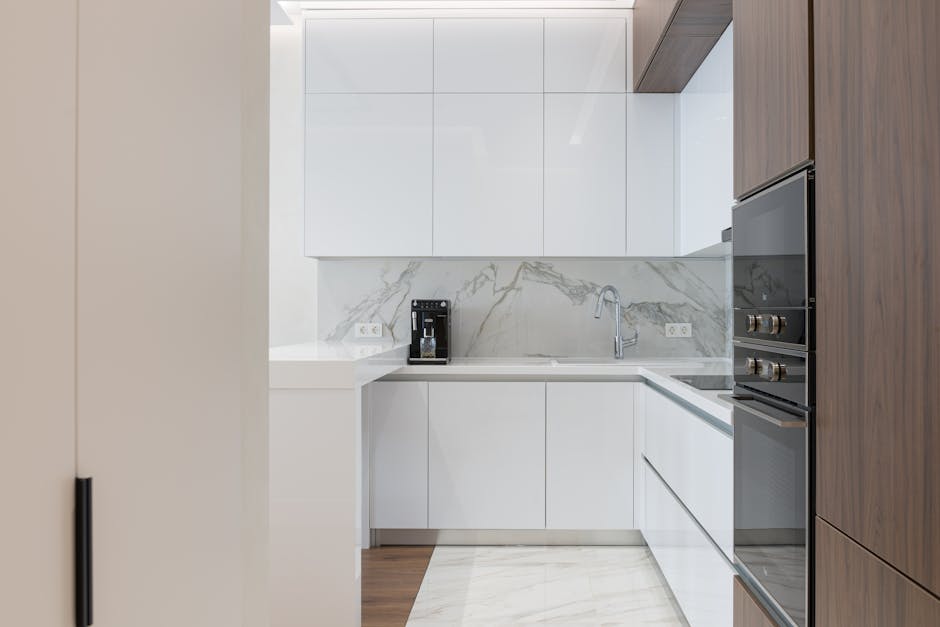
Gold foil stamped marble reads warm. The veining detail catches light with a yellow-gold undertone that ties into brass faucets, warm-toned wood cabinetry, and cream or off-white subway tile. Kitchens with honey-toned oak cabinets, unlacquered brass hardware, or warm beige countertops will look intentional with gold foil marble mats rather than mismatched.
The Gold Foil Stamped Marble Kitchen Mats ($29.99 for the two-piece set, 4.3/5 stars across 117 reviews) use white marble patterning with gold vein detail on a PVC leather-look surface. On light-colored tile — white, ivory, or pale gray — the contrast is dramatic in a good way. The mat reads as a design choice rather than a functional afterthought.
When Silver Foil Works Better
Silver foil is the contemporary option. Chrome faucets, brushed nickel hardware, white flat-panel cabinets, dark quartz countertops — silver foil marble feels native to that palette rather than imported into it. The Silver Foil Stamped Marble Kitchen Mats ($29.99, same dimensions and rating) run cooler in tone, and that coolness works especially well in all-white kitchens where you want the mat to recede visually rather than draw attention.
Both sets are the same price, same construction, same size pairing. The choice really does come down to your metal finishes. Look at your faucet. Warm metal (brass, gold, bronze) points to the gold foil version. Cool metal (chrome, brushed nickel, stainless) points to the silver. If you have mixed metals — which is common in kitchens renovated in stages — go silver. It’s neutral enough to bridge both.
The Marble Pattern as a Practical Design Strategy
Marble-patterned mats earn their keep in ways that solid-color mats don’t. Real marble flooring is cold, hard, expensive, and needs periodic resealing. A marble-pattern PVC mat gives you the visual gravitas of stone without requiring sealed grout, slippery-when-wet surfaces, or a floor contractor. More practically: marble patterns hide daily kitchen grime far better than solid colors. A solid black mat shows every breadcrumb and grease splatter. A marble-patterned mat — with its natural variation in white, gray, and vein tones — absorbs visual noise. After six months of daily cooking, the marble mats still photograph clean. The solid-color versions from the same product category look used.
Thickness and Density: The Specs That Actually Predict Comfort
Anti-fatigue mat marketing uses phrases like “ergonomic support” and “all-day comfort” without attaching any numbers. Here are the measurable specs that matter:
- Thickness at 10mm (2/5 inch): This is the functional sweet spot. Below 6mm, you’re not getting meaningful cushioning — you’re basically standing on a grippy flat surface. Above 15mm, the mat edge becomes a trip hazard, especially for older users or anyone moving quickly through the kitchen. The 10mm standard used in the marble foil PVC sets is substantial enough to reduce standing fatigue without creating a step-up at the edge.
- Construction density under load: A high-density PVC mat rated at 10mm stays near 10mm under a 180-pound person standing in one spot. An open-cell foam mat rated at 10mm compresses to 5–6mm under that same weight, then slowly recovers. Effective thickness under load is what your joints actually experience — not rated thickness in a product photo.
- Non-slip backing type: Micro-suction backing (tiny suction cups molded into the base) works best on smooth glazed tile. Textured rubber backing works better on textured tile or vinyl plank. Flat smooth backing is ineffective on almost any hard floor. Check which type is specified — not just whether the product claims “non-slip.”
- Edge bevel angle: Beveled edges (angled at roughly 45 degrees rather than cut vertically) eliminate the trip-hazard problem at mat edges. You can step over a beveled mat edge without catching your foot. Vertical-cut edges are fine when you step onto the mat deliberately but dangerous in kitchen traffic where people move fast without looking down.
- Surface texture: Smooth leather-look PVC surfaces wipe clean with a damp cloth or a spray of all-purpose cleaner. Textured foam surfaces trap cooking oil and food particles in the texture grooves, requiring scrubbing. In a kitchen environment — where grease splatter is a daily reality — smooth wipe-clean wins over textured every time.
These five specs let you evaluate any kitchen mat on its actual merits rather than its marketing language. A product that checks all five will last. A product that can’t answer all five — especially construction density under load and backing type — probably won’t.
Common Questions About Anti-Fatigue Kitchen Mats
Can PVC kitchen mats handle spills and standing water near the sink?
Yes, if the mat uses solid single-piece PVC construction. Spills bead up and wipe off the surface. The mat doesn’t absorb water, and the non-slip backing doesn’t degrade from wet exposure. The distinction that matters: “PVC surface” (a coating over foam) versus “solid PVC construction” (the PVC is the structural material throughout). The marble foil mats are the latter. Water exposure is not an issue for them.
Why does my new PVC mat have a smell?
New PVC products off-gas VOCs during the first 48–72 hours. This happens with budget products and premium ones alike — it’s a material property, not a quality indicator. Lay the mat flat in a ventilated space, ideally outdoors or near an open window, for two full days before putting it in your kitchen. The smell dissipates completely. If it hasn’t cleared after a week of ventilation, that’s worth flagging with the seller.
How do I stop a kitchen mat from sliding on polished porcelain tile?
Polished porcelain is the most difficult flooring surface for mat grip — it’s essentially glass-smooth. Three approaches work: micro-suction backing performs better on polished porcelain than rubber nubs do; a thin rug-grip underlay pad (cut to mat size) adds friction on any surface; or carpet tape on the mat corners provides near-permanent hold. Standard glazed ceramic tile — the matte-finish kind found in most kitchens — doesn’t require any of these workarounds. Micro-suction or rubber backing grips it fine on its own.
Do these mats work on radiant heated floors?
Radiant in-floor heating typically runs at 80–85°F at the surface. Solid PVC mats handle this range without softening or deforming. Open-cell foam mats can become pliable and shift shape over heated surfaces at sustained temperatures, which then affects their non-slip performance. If you have radiant heat, solid PVC or natural rubber-backed mats are the right choice. Foam-core mats — regardless of their surface material — are a poor match for heated floors.
The Verdict
For a home kitchen with daily use, the Gold Foil Stamped Marble Kitchen Mats two-piece set is the right buy for warm-toned kitchens with brass or gold hardware, and the Silver Foil version belongs in cool, contemporary kitchens with chrome or stainless finishes. Both deliver solid-PVC construction in the size pairing that actually matches how kitchens are used — and the marble pattern hides six months of daily cooking wear better than any solid-color mat at this price.